Proteolysis refers to protein breakdown. In the PROTAC context, the target protein is intended to be routed toward destruction rather than simply blocked.
Flagship Explainer
What Is a PROTAC?
A PROTAC, or proteolysis-targeting chimera, is a heterobifunctional small molecule designed to bring a protein of interest near an E3 ligase so the target protein can be tagged with ubiquitin and removed by the proteasome.
In plain language, a PROTAC is designed to remove a protein, not just block it. That idea is powerful, but it is also demanding: productive degradation depends on target binding, E3 recruitment, linker geometry, ternary complex formation, ubiquitination, cell context, and experimental validation.
Targeted protein degradation
Induced proximity
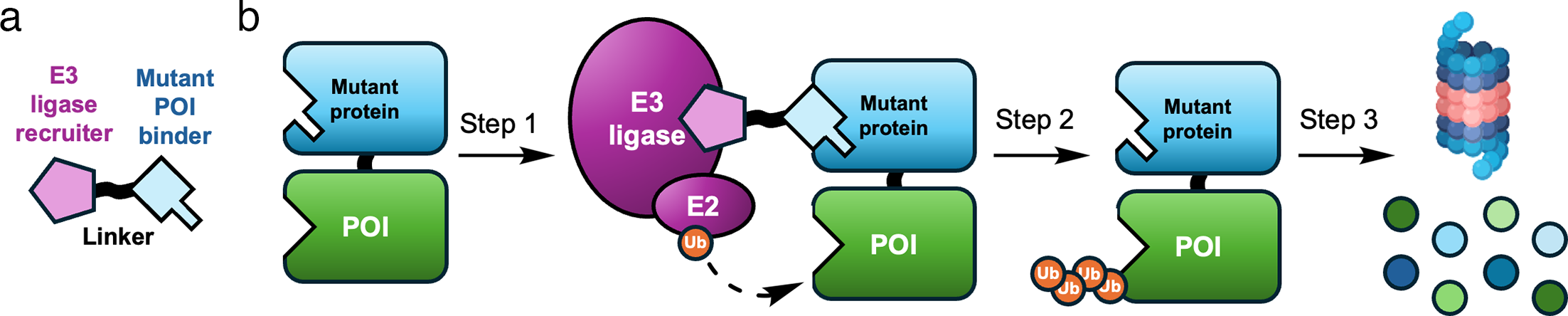
Warhead, linker, recruiter
Validation still required
Quick answer: what is a PROTAC?
A PROTAC is a bifunctional degrader molecule that links a protein-of-interest binder to an E3 ligase recruiter. When the molecule brings the target protein and E3 ligase together in a productive way, the target can be ubiquitinated and sent to the proteasome for degradation.
In one sentence: a PROTAC is designed to remove a protein, not just inhibit it.
What does PROTAC stand for?
Targeting means the molecule is designed to engage a specific protein of interest and recruit degradation machinery in a selective biological context.
Chimera reflects the combined architecture: one end binds the target, one end binds an E3 ligase, and a linker connects them into one degrader scaffold.
The acronym captures the key idea: PROTACs are proximity-inducing molecules built to connect target biology, ligase recruitment, and degradation machinery.
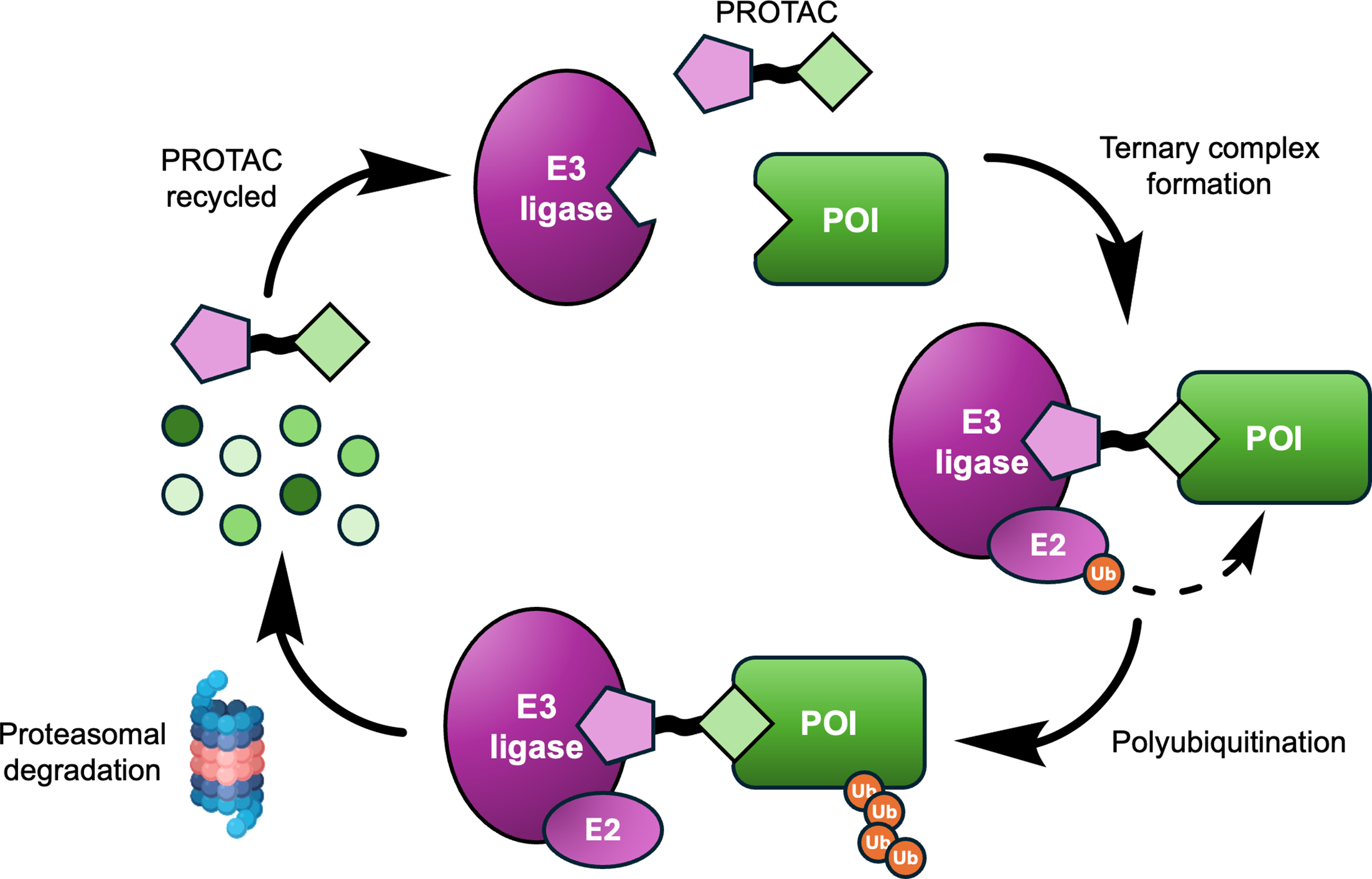
How do PROTACs work?
- The PROTAC enters the cell or otherwise reaches the relevant intracellular context.
- One end binds the protein of interest.
- The other end binds an E3 ligase or its recruiter pocket.
- The linker allows the target, PROTAC, and E3 ligase to form a ternary complex.
- If that ternary arrangement is productive, E3 ligase machinery can transfer ubiquitin to the target protein.
- A polyubiquitin chain can mark the target for proteasomal degradation.
- The proteasome degrades the target protein.
- The PROTAC may dissociate and participate in additional degradation cycles, but only when the system supports productive turnover.
Important caution: a PROTAC is designed to trigger this sequence, but productive degradation still
depends on geometry, ubiquitination competence, cellular exposure, and experimental validation.
The three parts of a PROTAC
Protein-of-interest warhead
The warhead binds the target protein. It may come from an inhibitor, ligand, fragment, covalent binder, or another known target-binding motif.
Good warheads usually preserve key target interactions while also leaving room for a plausible solvent-exposed attachment vector.
Linker
The linker connects the warhead to the recruiter and shapes reach, flexibility, rigidity, polarity, and bridgeability.
The linker is not passive. Too short, too long, too flexible, or too rigid can all undermine ternary complex formation.
E3 ligase recruiter
The recruiter binds an E3 ligase. E3 choice can affect ternary geometry, cell-context behavior, selectivity, and off-target risk.
CRBN and VHL are common examples, but they are not the only relevant ligases, and recruiter binding pose plus attachment atom still matter.
What is a PROTAC ternary complex?
A ternary complex is the three-part assembly formed by the protein of interest, the PROTAC, and the E3 ligase. This assembly is central to PROTAC activity because binary binding to both proteins is not enough on its own.
The target and E3 ligase must be oriented productively enough to support ubiquitination rather than just sitting near each other in an unhelpful way.
A PROTAC can bind both proteins and still fail if the linker path is strained, the protein-protein arrangement is wrong, or the ubiquitination geometry is poor.
Protein-protein contacts within the ternary complex can improve or weaken cooperativity, which can influence stability, selectivity, and degradation performance.
In PROTAC discovery, the real question is often not only whether each end binds, but whether the whole system can form a productive ternary complex.
Key idea: in PROTAC design, the question is not only “does each end bind?” but “can the whole
system form a productive ternary complex?”
What is ubiquitination?
Ubiquitin is a small protein tag used by cells to mark proteins for different fates. In PROTAC-mediated degradation, the recruited E3 ligase helps position the target so ubiquitin can be transferred onto the protein of interest.
- Polyubiquitin chains can signal that a target protein should be degraded by the proteasome.
- The exact outcome depends on target lysines, E3 machinery, geometry, residence time, and cell context.
- A visually plausible ternary model does not guarantee efficient or biologically meaningful ubiquitination.
What is proteasomal degradation?
The proteasome is a cellular machine that degrades many ubiquitin-tagged proteins. PROTACs aim to route a disease-relevant target into that system so the protein is removed from the cell rather than merely occupied by a blocking ligand.
That distinction matters because removing a protein can affect catalytic and non-catalytic functions, including scaffolding roles or signaling roles that simple inhibition may not fully address.
PROTAC vs traditional inhibitor
Usually binds and blocks a target protein while leaving that protein present.
Activity is often occupancy-driven and often focused on active sites or functional pockets.
Effect depends on sustained target engagement and does not necessarily remove non-catalytic protein functions.
Recruits an E3 ligase to promote degradation of the target protein.
Designed to remove the target protein rather than only block one functional site.
Depends on ternary complex formation, ubiquitination, cell context, and geometry in addition to binding.
Important nuance: PROTACs are not automatically better than inhibitors. Each modality has
strengths, limitations, and target contexts where it may be more or less appropriate.
PROTAC vs molecular glue
Usually contain two binding elements connected by a linker.
One end binds the protein of interest and the other binds an E3 ligase recruiter site.
Design often involves explicit warhead, recruiter, linker, and exit-vector optimization.
Usually are smaller molecules that stabilize or induce a protein-protein interaction.
They can recruit a target to an E3 ligase without a long bifunctional linker.
Their discovery can be less modular and more context-dependent than classic bifunctional PROTAC design.
Shared principle: both PROTACs and molecular glues are proximity-inducing degradation strategies,
but their architectures and discovery logic are often different.
Why linker geometry matters
Linker design is one of the most common reasons PROTACs succeed or fail. The linker controls the distance, direction, conformational freedom, and property burden that connect the target-facing and ligase-facing ends of the molecule.
- Too short can create impossible reach or severe steric clash.
- Too long can increase entropy and reduce the population of productive ternary states.
- Too rigid can overconstrain the system.
- Too flexible can create a large conformational search problem.
Why PROTAC design is hard
A molecule can bind both proteins but still fail to degrade the target.
Linker geometry can make or break ternary complex formation.
E3 ligase expression varies by cell type and tissue.
PROTACs are often large and polar, which can hurt permeability.
Accessible lysines and productive ubiquitination geometry still matter.
Hook effect can reduce degradation at high concentrations.
Solubility, metabolic stability, and synthesis feasibility still matter.
Computational models help prioritize but do not replace experiments.
Key PROTAC metrics
DC50
The concentration where 50% of maximal degradation is achieved in a defined assay context.
Dmax
The maximum observed degradation under the tested conditions.
Hook effect
Reduced degradation at high PROTAC concentration, often because binary complexes compete against productive ternary complexes.
Selectivity
Which proteins are degraded or spared across targets, isoforms, or broader proteomic context.
Target engagement
Evidence that the molecule binds the intended target in the relevant system.
Ternary cooperativity
Whether the POI-PROTAC-E3 assembly is more or less stable than expected from binary interactions alone.
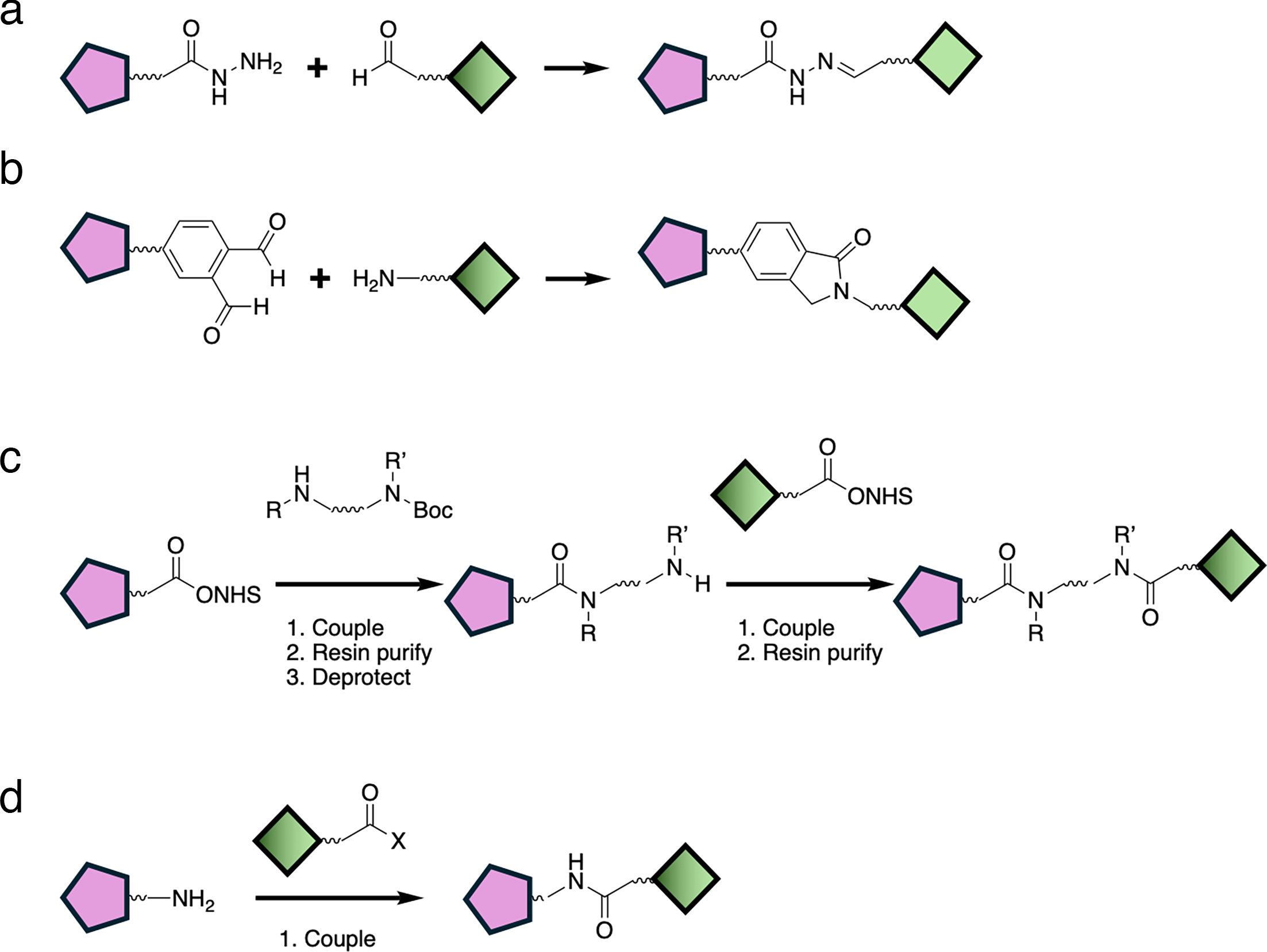
How scientists design PROTACs
- Choose a biologically meaningful protein of interest.
- Find or design a target-binding warhead.
- Choose an E3 ligase recruiter.
- Identify solvent-exposed attachment vectors.
- Build a linker panel instead of relying on one guess.
- Assemble candidate PROTACs.
- Check descriptors, geometry, and bridgeability.
- Model ternary complexes where appropriate.
- Test degradation experimentally.
- Iterate based on DC50, Dmax, selectivity, permeability, and structure-activity relationships.
How PROTAC Builder fits into PROTAC design
PROTAC Builder is a preparation and assembly layer for degrader design. It helps users organize candidate warheads, linkers, and recruiters; define attachment atoms; assemble candidate structures; compare component choices; and prepare handoffs into downstream modeling or batch workflows.
Organize warhead, linker, and recruiter components.
Define attachment atoms and component boundaries.
Assemble candidate PROTAC structures.
Compare linker, recruiter, and warhead hypotheses.
Prepare structures for downstream modeling.
Support API and batch-ready workflows.
Honest scope: PROTAC Builder helps create better-structured design hypotheses. It does not predict
or guarantee degradation, and experimental validation remains required.
Connected tool ecosystem
Warhead Hunter
Target-binding warhead discovery and target-context exploration before degrader assembly.
Open Warhead Hunter ↗E3 Ligandalyzer
Recruiter, scaffold, solvent exposure, and E3 context before final assembly.
Open E3 Ligandalyzer ↗V-LiSEMOD
Viral protein-ligand structures and solvent-exposed moieties for viral-target workflows.
Open V-LiSEMOD ↗PROTAC Builder
Assemble and organize candidate degraders once the component choices are ready.
Launch PROTAC BuilderDownstream Modeling
Move candidate degraders into ternary modeling, scoring, and validation handoff workflows.
Open downstream modelingBenchmarking
Review reporting standards, task definitions, and reproducibility expectations for computational PROTAC workflows.
Open benchmarkingCommon misconceptions about PROTACs
A PROTAC is not just two ligands glued together
Linker geometry, exit vectors, ternary complex formation, and protein-protein orientation matter as much as the component list.
Strong binding does not guarantee degradation
Binary affinity is only one part of the mechanism. Productive proximity and ubiquitination still have to happen.
The linker is not passive
It shapes distance, flexibility, polarity, property burden, and whether the whole degrader can actually work in 3D.
CRBN and VHL are not the only E3 ligases
They are common starting points, but E3 choice should still be context-aware and structure-aware.
A computational model is not proof of degradation
Models prioritize and explain. Assays validate.
A low DC50 is not the whole story
Dmax, selectivity, exposure, hook effect, and biological context still matter.
Frequently asked questions
What is a PROTAC in simple terms?
A PROTAC is a molecule designed to bring a target protein near an E3 ligase so the target can be marked for degradation.
What does PROTAC stand for?
PROTAC stands for proteolysis-targeting chimera.
How does a PROTAC degrade a protein?
It binds the target with one end, recruits an E3 ligase with the other, and can promote target ubiquitination if a productive ternary complex forms.
What are the three parts of a PROTAC?
The three main parts are a protein-of-interest warhead, a linker, and an E3 ligase recruiter.
What is the role of the linker in a PROTAC?
The linker controls reach, flexibility, polarity, and geometry between the target-binding and recruiter-binding ends.
What is an E3 ligase recruiter?
It is the PROTAC component that binds an E3 ligase and helps recruit ubiquitination machinery to the target.
Why do PROTACs need an E3 ligase?
Because the E3 ligase is part of the machinery that can attach ubiquitin to the target protein.
What is a ternary complex?
It is the three-part assembly of the target protein, the PROTAC, and the E3 ligase.
Are PROTACs the same as molecular glues?
No. Both are proximity-inducing strategies, but PROTACs are usually bifunctional linker-containing molecules, while molecular glues are usually smaller context-dependent interaction stabilizers.
How are PROTACs different from inhibitors?
Traditional inhibitors usually block target function while leaving the protein present. PROTACs are designed to remove the target protein through degradation.
Why can a PROTAC bind but fail to degrade?
Because binding alone is not enough. Ternary geometry, ubiquitination competence, exposure, and cell context still matter.
What is the hook effect?
It is reduced degradation at high PROTAC concentration, often because too much binary binding competes against productive ternary complex formation.
Can PROTAC Builder predict degradation?
No. PROTAC Builder is an assembly and workflow-preparation tool, not a guarantee of biological activity.
How do I start designing a PROTAC?
Start with a meaningful target, a target-binding warhead, an E3 recruiter, plausible attachment vectors, and a small linker panel, then move into modeling and experiments.
What should I read next?
The best next pages are the build guide, linker guide, E3 recruiter guide, constraint-driven design page, in silico modeling page, downstream modeling page, and benchmarking page.
Suggested reading and next steps
Warhead discovery
Target-binding chemistry, target context, and derivatization-aware warhead thinking.
Explore warheadsLinker design
Bridgeability, flexibility, polarity, and ternary-geometry reasoning.
Review linker designE3 recruiter discovery
Recruiter scaffolds, bound poses, and ligase-side attachment choices.
Explore E3 recruitersConstraint-driven design
Anchor-aware geometry before expensive modeling.
Open constraint-driven guideIn silico modeling
How docking, restrained modeling, ML, and hybrid workflows fit together.
Read modeling guideDownstream modeling
What happens after assembly: bridgeability, ternary modeling, scoring, and refinement.
Open downstream modelingBenchmarking
How to compare methods responsibly and report computational results clearly.
Open benchmarkingExamples
Workflow-oriented examples across the broader PROTAC Builder ecosystem.
Open examplesThis page is educational and intended as a flagship explainer for PROTAC Builder.